Invoice Payment Terms & Late Fees: The 2026 Guide to Getting Paid on Time
Master Net 15, Net 30, and Due Upon Receipt invoice terms. In-depth analysis of legal late fee caps across the US and UK, 2/10 Net 30 discount math, and copy-paste collection email scripts.

Late payments are the single greatest threat to small business survival. According to commercial banking data, more than 60% of small businesses and independent contractors experience severe cash flow bottlenecks caused by overdue client invoices. When clients delay payment by 30, 60, or 90 days, you effectively become an interest-free bank financing their payroll.
Establishing clear, legally enforceable invoice payment terms from day one transforms erratic payments into predictable working capital.
In this comprehensive guide, audited by the FeeKit Financial Engineering Desk for fiscal year 2026, we break down standard commercial payment terms, calculate the true cost of trade credit, review US and UK statutory interest caps, and provide battle-tested follow-up email scripts. You can generate professional, compliant PDF invoices immediately with our free Invoice Generator.
1. The 5 Core Invoice Payment Terms Explained#
Your invoice payment terms specify when payment is legally due, how the client must pay, and what penalties trigger if the deadline is missed.
| Payment Term | Definition | Best Used For | Risk Profile |
|---|---|---|---|
| Due Upon Receipt | Payment is expected immediately when the client opens the invoice. | Digital products, one-off consulting, short freelance projects. | Lowest Risk: Fast cash settlement. |
| Net 7 / Net 15 | Payment is required within 7 or 15 calendar days from invoice date. | Retainers, web agencies, weekly contractors, milestone completions. | Low Risk: Keeps working capital liquid. |
| Net 30 | Payment is due 30 days after the invoice date. | Standard enterprise B2B corporate contracts, institutional clients. | Moderate Risk: High reliance on client accounting cycles. |
| Net 60 / Net 90 | Payment is due 60 or 90 days after invoice date. | Large enterprise corporations, retail distributors, government bids. | High Risk: Severe cash drag; requires line of credit. |
| 2/10 Net 30 | 2% cash discount if paid in 10 days; full balance due in 30 days. | High-volume wholesale orders, long-term B2B client relationships. | Incentive-Driven: Trades margin for speed. |
2. The Hidden Cost of "Net 30": Why Trade Credit Hurts Solopreneurs#
When corporate clients demand Net 30, they are treating your service business as a vendor extending trade credit.
Consider this real-world scenario:
- You complete a $5,000 project on June 1st.
- You issue a Net 30 invoice due July 1st.
- The client’s accounts payable department only runs checks bi-weekly, delaying payment to July 15th (45 days total).
- Meanwhile, your personal living expenses, software subscriptions, and estimated quarterly taxes must still be paid on time.
If your cost of capital (or interest on business credit cards) is 12% APR, waiting 45 days on $5,000 costs you directly in lost liquidity and opportunity costs.
[!TIP] Contractor Best Practice: Unless you are negotiating with a Fortune 500 company whose procurement mandate strictly requires Net 30, always default your client contracts to "Due Upon Receipt" or "Net 15".
3. The Mathematics of Cash Discounts: Is "2/10 Net 30" Worth It?#
Offering an early payment discount like 2/10 Net 30 encourages corporate accounting departments to bump your invoice to the top of the queue. But does giving away 2% make financial sense?
Let's calculate the annualized interest rate represented by 2/10 Net 30:
Annualized APR = [Discount % ÷ (100 - Discount %)] × [365 ÷ (Total Days - Discount Days)]
APR = (2 ÷ 98) × (365 ÷ 20) = 0.0204 × 18.25 = 37.24% APR
When to Offer It:#
- When your business is experiencing acute cash flow constraints and requires immediate liquidity to cover payroll or taxes.
- When working with established corporations that have formal discount-capture policies in their ERP systems.
When NOT to Offer It:#
- On small invoices under $1,000, where a 2% deduction ($20) does not motivate corporate payment speed and unnecessarily reduces your margin. Use our Freelance Hourly Rate Calculator to factor payment timelines into your baseline pricing.
4. Legal Framework: Can You Legally Charge Late Fees?#
You cannot invent a penalty after an invoice goes unpaid. To collect late fees legally, two conditions must be met:
- Prior Agreement: The late payment terms must be documented in your signed statement of work (SOW), master services agreement (MSA), or clear invoice contract before work commenced.
- Statutory Usury Compliance: Your interest rate cannot exceed federal, state, or national statutory legal caps.
United States: State Usury Caps#
In the US, commercial late fees are governed by state contract and usury statutes:
- The Standard Rate: The widely accepted commercial baseline is 1.5% per month (18% annualized APR) or a reasonable flat administrative late fee ($25 to $50).
- State Ceilings: Certain states (such as New York, California, and Texas) strictly regulate usury caps on informal credit. Exceeding 18% to 24% without a formal lending license can render your entire collection claim unenforceable.
United Kingdom: The Late Payment of Commercial Debts Act#
The UK provides some of the strongest statutory protections in the world for B2B suppliers under the Late Payment of Commercial Debts (Interest) Act 1998:
- Statutory Interest: You are legally entitled to claim interest of 8% plus the Bank of England base rate on all overdue commercial payments.
- Fixed Compensation: You can claim statutory debt recovery costs based on invoice value:
- Invoices under £1,000: £40 compensation
- Invoices £1,000 to £9,999: £70 compensation
- Invoices £10,000 and above: £100 compensation
5. Exactly What Every Legally Binding Invoice Must Contain#
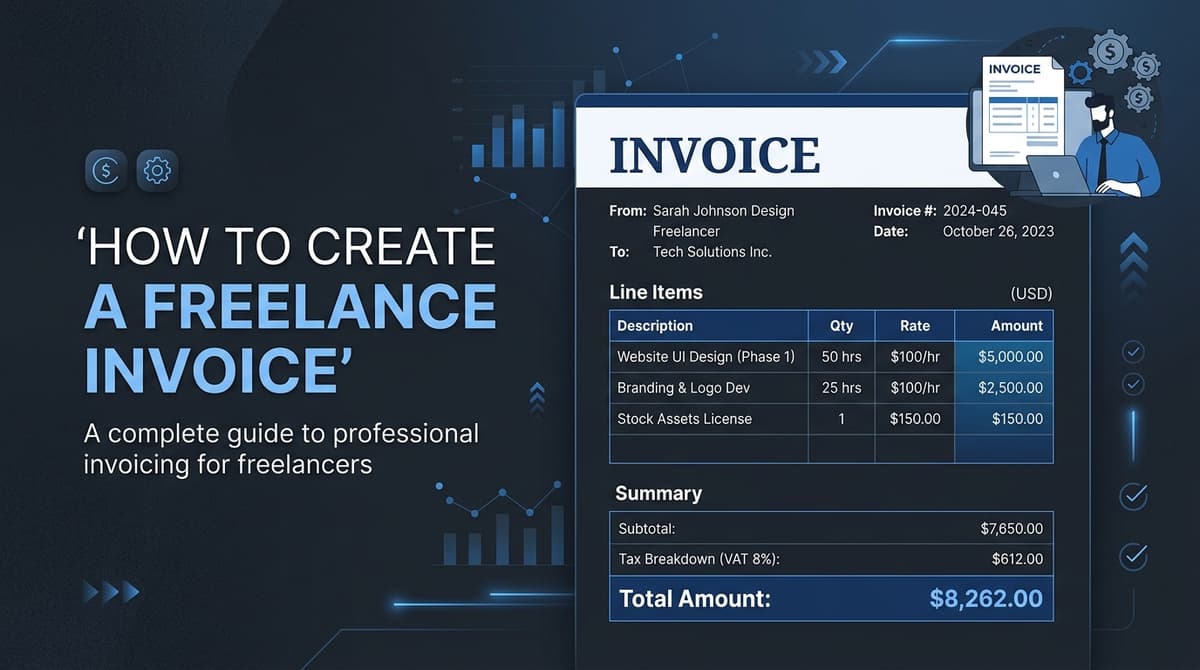
To prevent client accounting departments from claiming "we never received proper billing details," ensure your invoice includes every required field:
- Unique Invoice Number: Sequential tracking (e.g.,
INV-2026-0042). - Your Full Business Identity: Trading name, registered address, tax ID (EIN / SSN in US, VAT number in UK/EU), and support email.
- Client Identification: Company name, billing address, and point-of-contact email.
- Issue Date & Explicit Due Date: Avoid writing only "Net 30"—specify the exact calendar deadline: "Due Date: October 26, 2026".
- Itemized Scope of Services: Clear deliverables, quantities, hourly units, and subtotal.
- Applicable Taxes: Separately itemized state sales tax or VAT. Use our Sales Tax & VAT Calculators to verify precise local jurisdiction rates.
- Explicit Payment Instructions: ACH routing/account numbers, wire coordinates, or direct Stripe/PayPal payment links.
- Contractual Late Fee Clause: Clear statement of late interest:
“Invoices unpaid after 30 days are subject to a 1.5% monthly late fee or statutory interest pursuant to contract.”
You can create an invoice with all these fields pre-formatted in 30 seconds using FeeKit's free PDF Invoice Generator.
6. Three Copy-Paste Follow-Up Scripts for Overdue Invoices#
Never let an overdue invoice linger in silence. Use these three calibrated templates:
Script 1: The Polite Reminder (Day 1 Overdue)#
Subject: Friendly reminder: Invoice [INV-2026-001] for [Project Name] was due yesterday
Hi [Client Name],
Hope you're having a productive week!
This is a quick note to check if you received invoice [INV-2026-001] for $[Amount], which was due on [Due Date]. I’ve re-attached a copy for your convenience.
Please let me know once payment has been initiated, or if your finance team needs any additional vendor details from my side.
Best regards,
[Your Name]
Script 2: The Direct Professional Check-In (Day 7 Overdue)#
Subject: Outstanding Invoice [INV-2026-001] — [Amount] (7 days past due)
Hi [Client Name],
I am following up on invoice [INV-2026-001], which is now 7 days past due.
As a reminder, our agreement includes a 1.5% monthly finance charge on balances past due. To prevent any billing adjustments, please confirm when payment will be processed this week.
You can complete payment directly via bank transfer or credit card using the details on the invoice.
Thank you,
[Your Name]
Script 3: The Work-Pause & Final Notice (Day 15 Overdue)#
Subject: URGENT: Overdue Account Balance & Project Pause Notice — [Project Name]
Dear [Client Name],
Despite multiple reminders, invoice [INV-2026-001] for $[Amount] remains unpaid and is now 15 days past due.
Pursuant to Section [X] of our agreement, active project milestones and deliverables are temporarily paused until outstanding balances are cleared. Furthermore, an initial late fee of $[Late Fee Amount] has been assessed to your account.
Please remit payment immediately or reply today with proof of electronic transfer so we can resume work without further delay.
Sincerely,
[Your Name]
7. How to Automate Invoicing and Never Chase Clients Manually#
Chasing unpaid invoices manually through email is mentally exhausting and wastes valuable billable hours.
Modern service businesses streamline this workflow through two essential habits:
- Require an Upfront Deposit: Never start work for a new client with $0 down. Require 33% to 50% upfront deposit before kicking off design, development, or consulting milestones.
- Use Automated Recurring Invoicing: Platforms like FreshBooks automatically dispatch professional invoices, send polite automated payment reminder emails at 3, 7, and 14 days, and automatically levy late fees—taking the emotional friction out of collections.
Related Financial Precision Tools#
- Free PDF Invoice Generator — Create and download compliant invoices instantly without watermarks.
- Interchange-Plus vs Flat-Rate Pricing Guide — How to slash credit card processing cuts on invoice client transactions.
- Freelance Hourly Rate & Tax Suite — Calculate your true net take-home pay after 1099 taxes and overhead.
- Stripe Processing Fee Calculator — Model exact merchant cuts across US and UK client transactions.
- Ecommerce Profit Margin Calculator — Audit net operating margins across commercial sales channels.
Common Inquiries & Regulations
What is the standard payment term for small businesses and freelancers?
The most common standard B2B payment term is Net 30, meaning payment is due within 30 calendar days from invoice issuance. However, for independent contractors and service businesses, 'Due Upon Receipt' or 'Net 15' is strongly recommended to protect cash flow.
Can I legally charge interest or late fees on overdue invoices?
Yes, provided the late fee policy was clearly disclosed in your original signed agreement or engagement contract prior to commencing work. In the US, state usury laws cap late payment interest (typically 1.5% per month or 18% APR). In the UK, the Late Payment of Commercial Debts Act allows statutory interest of 8% plus the Bank of England base rate, plus fixed debt recovery compensation (£40 to £100).
What does '2/10 Net 30' mean?
'2/10 Net 30' offers the client a 2% discount on the total invoice amount if paid within 10 days; otherwise, the full balance is due within 30 days. This provides a strong cash flow incentive for prompt payment.
What should I do when an invoice is 30 days past due?
First, send a polite written reminder with the original PDF invoice re-attached. If unpaid after 7 days, pause ongoing deliverables, call the primary accounting contact directly, and send a formal Notice of Overdue Payment specifying applicable contractual late interest.
Test These Numbers With Your Exact Transaction Data
Don't guess your margins. Use FeeKit's free, client-side financial precision tools to model your exact gross revenue, deductions, and tax compliance: