
Invoice vs Receipt: What's the Difference and When to Use Each
Understand the legal and accounting differences between an invoice and a receipt. Learn when to issue each document, tax recordkeeping requirements, and audit trail rules.

While the terms invoice and receipt are frequently used interchangeably in everyday conversation, they serve opposite functions in commercial accounting and tax compliance.
Confusing the two creates friction in client billing, leads to uncollected accounts receivable, and creates serious documentation vulnerabilities during IRS or HMRC tax audits.
In this guide from the FeeKit Editorial Desk, we examine the precise operational and legal distinctions between invoices and receipts, when small businesses must issue each document, and how to maintain compliant records for tax season.
High-Level Comparison: Invoice vs Receipt#
The core distinction between the two documents comes down to timing and obligation: an invoice establishes a debt, while a receipt proves that a debt was extinguished.
| Dimension | Invoice | Receipt |
|---|---|---|
| Timing | Issued before or upon delivery of goods/services | Issued after payment is received |
| Purpose | Requests payment & sets legal payment terms | Acknowledges payment & provides legal proof of purchase |
| Accounting Function | Creates an Account Receivable for seller, Account Payable for buyer | Closes the receivable/payable entry; records cash transfer |
| Primary Recipient | Accounts payable department or client billing manager | Buyer, accounting records, tax audit archive |
| Contains Payment Terms? | Yes (e.g., Due in 30 days, Net 15, late fee clauses) | No (Payment has already occurred) |
| IRS / Tax Role | Documents business purpose and agreed contract terms | Proves actual monetary disbursement for deduction |
What Is an Invoice?#
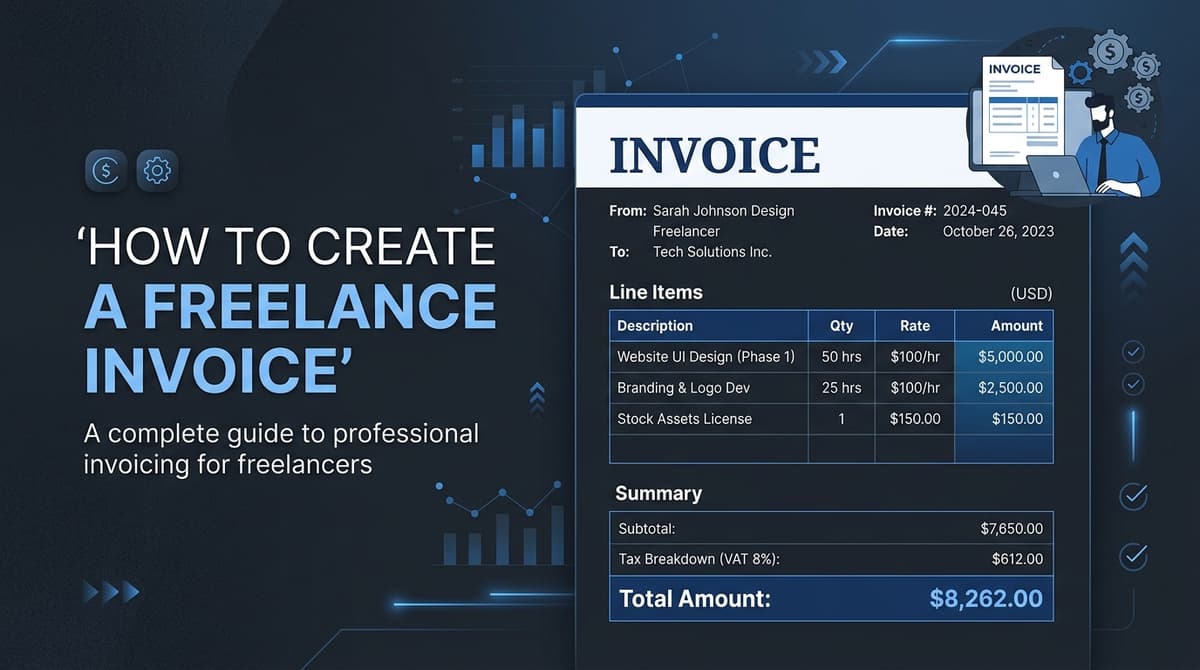
An invoice is a formal commercial document provided by a vendor or service provider to a client. It communicates:
- What products or professional services were delivered.
- The unit costs, hourly rates, and agreed milestone fees.
- Applicable sales taxes, value-added taxes, or negotiated discounts.
- The payment deadline (e.g., Net 30, Due upon Receipt).
- Instructions detailing acceptable payment methods (bank routing numbers, SWIFT/IBAN, credit card links).
In double-entry accrual accounting, issuing an invoice generates an Account Receivable (A/R) on the seller's balance sheet and an Account Payable (A/P) on the client's balance sheet.
You can create standardized, client-ready PDF invoices using our Free Invoice Generator.
What Is a Receipt?#
A receipt is a proof-of-payment document issued to the buyer once funds have cleared. It acts as legal confirmation that:
- The customer successfully transferred funds.
- The outstanding invoice or retail purchase has been settled in full (or partially).
- The seller has surrendered rights to further collection on that specific transaction.
In small-business bookkeeping, a receipt allows the business owner to move the transaction from "Pending Accounts Receivable" into "Cash / Bank Accounts".
Required Elements of a Legally Compliant Receipt#
Under standard commercial regulations, a valid receipt must contain:
- Title: Clearly labeled as a "Receipt", "Payment Receipt", or "Payment Confirmation".
- Seller Information: Business name, contact address, tax ID (EIN or VAT registration number).
- Transaction Date: The exact date the payment was received.
- Original Invoice Reference: If settling an invoice, the invoice number (e.g. "Payment for Invoice INV-2026-042").
- Amount Paid & Remaining Balance: Exact numerical amount received and any remaining unpaid balance.
- Payment Method: How the client paid (e.g., "Direct ACH Transfer Ref #987654" or "Visa ending in 4321").
The Tax Law Perspective: IRS and HMRC Documentation Rules#
Both the United States Internal Revenue Service (IRS) and the United Kingdom HM Revenue & Customs (HMRC) require businesses to maintain verifiable audit trails for income and deductible business expenses.
IRS Documentary Evidence Rules#
Under Treasury Regulation § 1.274-5 and IRS Publication 463, business owners must retain documentary evidence (such as receipts, canceled checks, or bills) for any business expense exceeding $75.00 (and for all lodging expenses regardless of amount).
To substantiate an expense deduction, the IRS demands evidence proving four elements:
- Amount: The cost of the item or service.
- Time and Place: When and where the expense was incurred.
- Business Purpose: Why the expense was necessary for your business operations.
- Business Relationship: The identities of the parties involved.
Crucial distinction: A credit card statement shows that money left your bank account, but it does not prove what was purchased. If you purchase $400 of computer hardware from a retailer, a credit card statement only shows a $400 charge; the IRS requires the itemized receipt showing the exact items purchased to verify that the expense was ordinary and necessary.
UK HMRC VAT Evidence#
For UK businesses claiming input VAT refunds on business expenses, an ordinary credit card slip or simple receipt is insufficient if the purchase exceeds £250. HMRC requires a Full VAT Invoice showing the supplier's VAT registration number, the date of supply, and the breakdown of VAT rates applied.
When Should a Business Issue Which Document?#
To streamline your customer interactions and avoid administrative confusion, follow these standard operational rules:
Scenario A: Project Work, Consulting, or Agency Retainers#
- You agree to deliver a 3-month software project for a client.
- You complete Milestone 1 and issue an Invoice for $5,000 with Net 15 payment terms.
- The client receives the invoice, processes it through their accounts payable system, and wires $5,000 to your business checking account 12 days later.
- Upon verifying that the funds have cleared, your bookkeeping system issues a Payment Receipt confirming receipt of the $5,000 payment for Milestone 1.
Scenario B: E-Commerce or Instant Digital Deliveries#
- A customer visits your online store and purchases a digital template or physical item with a credit card.
- The payment gateway (e.g., Stripe, Shopify Payments) charges the card instantly.
- Because payment and order placement occur simultaneously, the checkout system immediately generates a Receipt / Order Confirmation. An outstanding invoice is not needed unless the customer specifically requests a tax invoice for their corporate expense report.
Scenario C: Retainer Deposits or Down Payments#
When demanding a 50% upfront deposit before beginning work, issue an invoice specifically designated as a "Deposit Invoice" or "Milestone 1 Advance". Once the deposit clears your account, provide a receipt and begin the project.
Common Mistakes Small Businesses Make#
- Failing to Send Invoices Promptly: Invoicing delays directly correlate with payment delays. Sending invoices within 24 hours of milestone completion reduces average accounts receivable aging by 7 to 12 days.
- Treating Bank Statements as Receipts: A bank statement confirms funds movement, but lacks itemization. Always save digital receipts for software subscriptions, hardware purchases, and contractor payments in a cloud folder organized by fiscal year.
- Not Stamping Paid Invoices: If a client requests a receipt for an invoice they just paid, open your invoicing system, stamp the invoice PAID with the payment date and transaction ID, and re-export the PDF.
Explore our Small Business Resources Hub for comprehensive bookkeeping guides, profit margin tools, and fee calculators.
Common Inquiries & Regulations
What is the primary difference between an invoice and a receipt?
An invoice is a request for payment issued by a seller before payment is received, detailing goods or services provided, payment terms, and the balance due. A receipt is an acknowledgment of payment issued after money has changed hands, serving as legal proof of transaction completion.
Can an invoice serve as a receipt?
An invoice can only function as a receipt if it is explicitly stamped or printed with 'PAID', including the date payment was received, the payment method (e.g. wire transfer, card ending in 1234), and transaction reference number. An un-stamped invoice merely proves money was requested, not that it was actually paid.
Does the IRS require an invoice or a receipt to deduct business expenses?
For tax audit defense, the IRS generally requires documentary evidence that proves both the business nature of the expense (provided by an itemized invoice or detailed receipt) and actual payment remittance (proven by a receipt, canceled check, or credit card bank statement). For expenses over $75, an itemized receipt is mandatory under Treasury Regulation § 1.274-5.
Test These Numbers With Your Exact Transaction Data
Don't guess your margins. Use FeeKit's free, client-side financial precision tools to model your exact gross revenue, deductions, and tax compliance: