

Quarterly Estimated Taxes in 2026: Deadlines, Safe Harbor Rules & Calculator
Master IRS 2026 quarterly estimated tax payments for 1099 freelancers and LLCs. Form 1040-ES due dates, the 100%/110% safe harbor penalty rules, SECA tax formulas, and payment methods.

When professionals transition from traditional W-2 employment to independent contracting, freelancing, or launching an LLC, their first major financial shock is the realization that taxes are no longer automatically withheld from their paychecks.
As an independent business owner, the IRS operates on a strict "pay-as-you-earn" mandate. You cannot simply wait until April 15 of next year to pay your accumulated income and self-employment taxes in one lump sum.
If you owe $1,000 or more in annual federal tax liability, failing to submit payments in four equal quarterly installments triggers mandatory IRS underpayment penalties and compounding daily interest charges (IRC § 6654).
In this comprehensive 2026 tax strategy guide by the FeeKit Financial Engineering Team, we demystify the official 2026 Form 1040-ES deadlines, explain the 100% and 110% Safe Harbor rules to legally eliminate penalties, demonstrate the exact mathematical withholding formula, and outline the best electronic payment portals.
Calculate your exact quarterly obligations instantly using our free Quarterly Estimated Tax Calculator and protect your client earnings with our Freelance Rate Calculator.
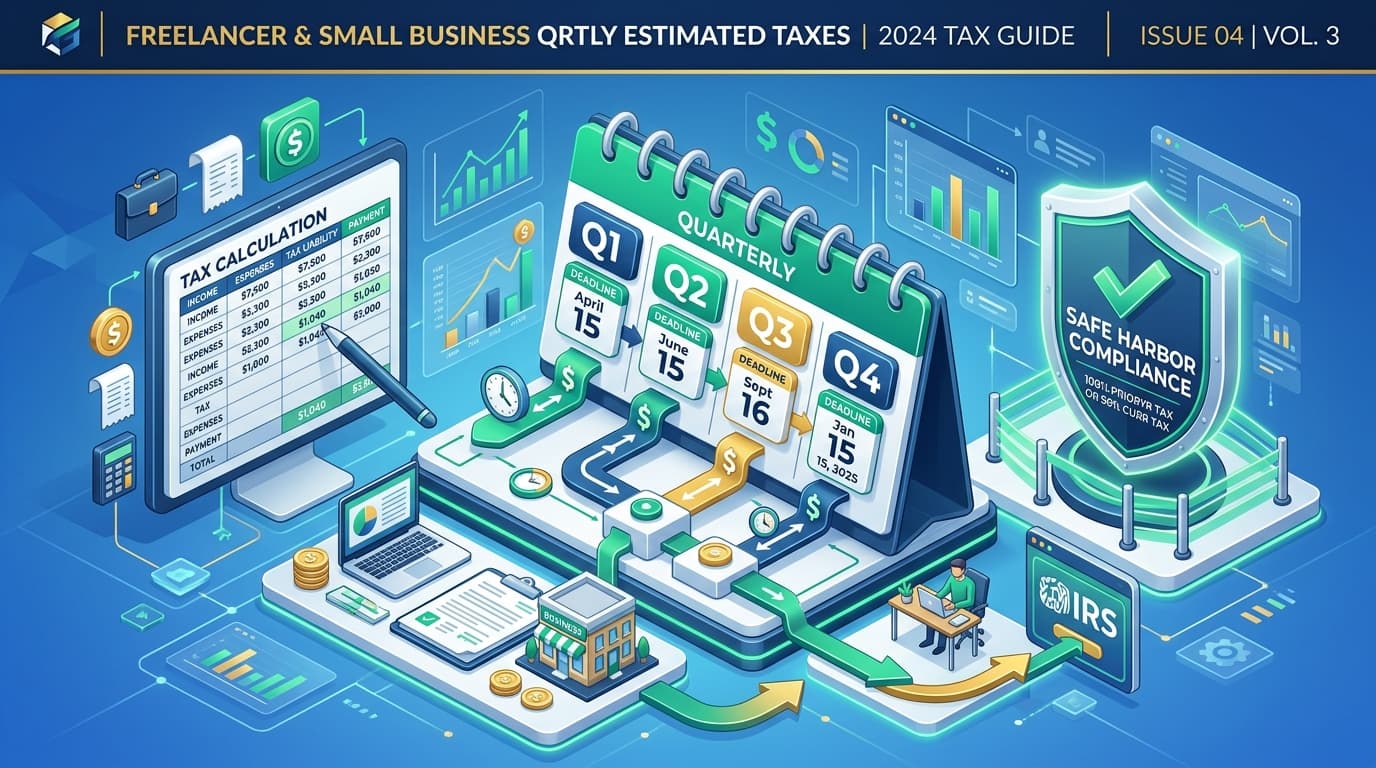
The Official 2026 IRS Estimated Tax Deadlines#
The most dangerous trap for new freelancers is assuming that tax quarters follow the standard three-month calendar quarters. They do not.
The IRS calendar divides the year unevenly: Quarter 1 is three months, Quarter 2 is only two months, Quarter 3 is three months, and Quarter 4 is four months.
| Tax Quarter | Income Earning Period | Official Payment Due Date | Number of Months |
|---|---|---|---|
| Q1 (Spring) | January 1 – March 31, 2026 | Wednesday, April 15, 2026 | 3 Months |
| Q2 (Summer) | April 1 – May 31, 2026 | Monday, June 15, 2026 | 2 Months (Trap!) |
| Q3 (Fall) | June 1 – August 31, 2026 | Tuesday, September 15, 2026 | 3 Months |
| Q4 (Winter) | September 1 – December 31, 2026 | Friday, January 15, 2027 | 4 Months |
Crucial Cash Flow Warning: Notice that Quarter 2 is due only 60 days after Quarter 1. Many freelancers deplete their tax reserves paying Q1 on April 15, only to be hit with Q2 just eight weeks later on June 15. Always budget your cash flow knowing Q2 arrives early!
Who Is Legally Required to Pay in 2026?#
According to IRS guidelines, you must make quarterly estimated payments if you meet both of the following criteria:
- You expect to owe at least $1,000 in federal tax for the current year (after subtracting any federal income tax withholding and refundable tax credits).
- You expect your total withholding and credits to be less than the smaller of:
- 90% of the tax shown on your current year's return.
- 100% of the tax shown on your prior year's return (provided your prior year return covered 12 months).
Common Profiles Subject to Estimated Taxes:#
- 1099-NEC / 1099-MISC Independent Contractors (freelance developers, designers, copywriters, agency owners).
- Sole Proprietors and Single-Member LLCs reporting profit on Schedule C.
- Partners in Multi-Member LLCs or Partnerships receiving Schedule K-1 distributions.
- S-Corporation Shareholders receiving profit distributions above their W-2 reasonable salary.
- Investors and Landlords with significant dividend, interest, capital gain, or rental real estate income.
The Safe Harbor Rule: The Bulletproof Way to Eliminate Penalties#
The single most valuable tax rule every self-employed person must memorize is the IRS Safe Harbor provision.
If your business has a windfall year where profits surge from $60,000 to $200,000, calculating your exact current-year tax liability is almost impossible. Fortunately, the IRS provides a legal guarantee: you cannot be penalized for underpaying your taxes if you meet the Safe Harbor benchmark.
The Two Safe Harbor Methods:#
SAFE HARBOR OPTION 1: Prior-Year Tax Liability (Most Popular)
• If your prior year Adjusted Gross Income (AGI) was $150,000 or LESS:
  Pay 100% of your total tax from last year's return divided into 4 equal installments.

• If your prior year Adjusted Gross Income (AGI) was OVER $150,000 (or $75,000 MFS):
  Pay 110% of your total tax from last year's return divided into 4 equal installments.

SAFE HARBOR OPTION 2: Current-Year Tax Liability
• Pay at least 90% of your actual final tax liability for the current tax year.
Real-World Safe Harbor Example:#
Suppose your total federal tax on your 2025 Form 1040 (Line 24) was $12,000, and your AGI was under $150,000.
- Even if your business explodes in 2026 and your real tax bill will be $30,000, your Safe Harbor requirement is simply:
Quarterly Installment = $12,000 ÷ 4 = $3,000 per quarter - You pay $3,000 on each of the four deadlines ($12,000 total).
- When you file your final return in April 2027, you simply pay the remaining $18,000 balance in a lump sum.
- The IRS cannot charge you a single penny in underpayment penalties, because you satisfied the 100% Safe Harbor threshold!
Step-by-Step Mathematical Calculation Formula#
If you prefer to pay estimated taxes based on your actual projected earnings rather than last year's return, follow this 4-step financial formula:
Step 1: Calculate Net Schedule C Profit#
Taxes are paid on net profit, never on gross revenue:
Net Profit = Gross Invoiced Income - Deductible Business ExpensesExample: $100,000 gross invoicing - $20,000 expenses = $80,000 net profit.
Step 2: Calculate Self-Employment (SECA) Tax#
As a 1099 contractor, you must pay both the employer and employee portions of Social Security (12.4%) and Medicare (2.9%), totaling 15.3%:
SECA Taxable Base = Net Profit × 0.9235
Self-Employment Tax = SECA Taxable Base × 0.153 (15.3%)
For $80,000 net profit: $80,000 × 0.9235 = $73,880 × 0.153 = $11,303.64.
Step 3: Calculate Federal Income Tax (After Deductions)#
You are entitled to deduct half of your self-employment tax ($5,651.82) from your Adjusted Gross Income, plus your Standard Deduction ($15,000 for single filers in 2026) and the 20% Qualified Business Income (QBI) deduction under Section 199A.
Your remaining taxable income is then taxed at your marginal federal brackets (10%, 12%, 22%, 24%).
Step 4: Divide by Four#
Add your total Self-Employment Tax plus your Federal Income Tax, and divide by 4 to determine your quarterly payment:
Quarterly Installment = Total Annual Estimated Tax ÷ 4Interactive Live Fee & Rate Calculator#
Audit your client revenue, profit margins, and net payouts with our interactive calculator:
Live Revenue & Margin Calculator Live Tool
Calculate exact gross-up totals and avoid losing 3% to card processors
The Cost of Non-Compliance: How IRS Penalties Work#
What actually happens if you skip your quarterly estimated payments?
The IRS assesses an underpayment penalty under IRC § 6654 using Form 2210. The penalty is calculated as an interest charge on the amount underpaid for the number of days it was delinquent.
Key Penalty Facts:#
- The Interest Rate is Tied to the Federal Short-Term Rate: The IRS interest rate on underpayments is adjusted quarterly and currently sits around 7% to 8% annually.
- Penalties Compound Daily: The longer an installment goes unpaid, the higher the penalty climbs.
- Paying Everything in Q4 Does Not Erase Earlier Penalties: A common mistake is paying zero in Q1, Q2, and Q3, and trying to pay the entire balance in Q4. Because the IRS looks at each quarter individually, you will still be assessed interest on the missing Q1, Q2, and Q3 installments!
- W-2 Withholding Exception: If you have a spouse with a W-2 job or you work a side W-2 role, you can increase your W-4 withholding late in the year. Unlike estimated payments, W-2 withholding is treated by the IRS as having been paid equally throughout the year, allowing you to backfill missed quarterly payments!
How to Pay the IRS: The 3 Best Portals#
Never mail paper checks with Form 1040-ES payment vouchers if you can avoid it. Mail delays and manual IRS processing backlogs can lead to mistaken penalty notices. Instead, use these electronic portals:
1. IRS Direct Pay (Free & Instant — Recommended)#
- URL: irs.gov/directpay
- Cost: 100% Free bank account (ACH) transfer.
- Reason for Payment: Select "Estimated Tax" -> Tax Year "2026" -> Form "1040-ES".
- Proof: Generates an immediate confirmation number you can save for your CPA.
2. Electronic Federal Tax Payment System (EFTPS)#
- URL: eftps.gov
- Ideal for businesses and LLCs. Allows you to schedule all four quarterly payments at the beginning of the year so you never miss a deadline.
3. Credit Card Payment (Not Recommended)#
- While the IRS allows payment via third-party processors (PayUSAtax, ACI Payments), they charge convenience fees of 1.85% to 1.98%. Unless you are meeting a major credit card sign-up bonus, stick to free bank transfers.
Don't Forget State Estimated Taxes!#
Federal taxes are only half the battle. If you live in a state with personal income tax (such as California, New York, New Jersey, Massachusetts, or Illinois), you are also required to make state quarterly estimated tax payments.
- California (FTB 540-ES): Follows an unusual 30% / 40% / 0% / 30% payment schedule (30% due April 15, 40% due June 15, 0% due September 15, 30% due January 15).
- New York (IT-2105): Follows standard 25% quarterly installments matching federal deadlines.
- States with Zero Income Tax: If you operate in Alaska, Florida, Nevada, South Dakota, Tennessee, Texas, Washington, or Wyoming, you owe zero state estimated income taxes!
Calculate your destination state taxes with our 50-State Sales Tax Hub and audit your invoice cash flow with our Free Invoice Generator.
Common Inquiries & Regulations
What are the IRS quarterly estimated tax deadlines for 2026?
The official 2026 IRS Form 1040-ES quarterly estimated tax deadlines are: Q1 (Jan 1 – Mar 31) due April 15, 2026; Q2 (Apr 1 – May 31) due June 15, 2026; Q3 (Jun 1 – Aug 31) due September 15, 2026; and Q4 (Sept 1 – Dec 31) due January 15, 2027. If a deadline falls on a weekend or federal holiday, it shifts to the next business day.
Who is required to pay quarterly estimated taxes in 2026?
Individuals, independent 1099 contractors, freelancers, sole proprietors, and single-member LLC owners who expect to owe $1,000 or more in federal tax liability when filing their annual return (after subtracting withholding and refundable credits) are legally required by the IRS to make quarterly estimated payments.
What is the IRS Safe Harbor rule to avoid underpayment penalties?
Under the IRS Safe Harbor rule, you will avoid all underpayment penalties if your quarterly payments equal at least: (1) 100% of your total tax liability from the previous tax year (increased to 110% if your Adjusted Gross Income exceeded $150,000 for married filing jointly or single), OR (2) 90% of your actual tax liability for the current tax year.
What is the IRS penalty for missing a quarterly estimated tax deadline?
The IRS assesses an underpayment penalty under IRC Section 6654 calculated based on the statutory federal interest rate (currently around 7% to 8% annually). The penalty compounds daily on the unpaid balance from the day the installment was due until the date paid or April 15 of the following year.
Why is the second quarter of estimated taxes only two months long?
The IRS does not use equal three-month calendar quarters. Q1 covers 3 months (Jan-Mar, due Apr 15), Q2 covers only 2 months (Apr-May, due Jun 15), Q3 covers 3 months (Jun-Aug, due Sep 15), and Q4 covers 4 months (Sep-Dec, due Jan 15). Many freelancers are caught off guard by Q2 being due just 60 days after Q1.
Test These Numbers With Your Exact Transaction Data
Don't guess your margins. Use FeeKit's free, client-side financial precision tools to model your exact gross revenue, deductions, and tax compliance: