
How to Create an Invoice for Freelance Work: Step-by-Step Guide & Checklist
Learn how to format, itemize, and issue a professional freelance invoice. Includes mandatory fields, payment terms, sales tax rules, late fee clauses, and invoice generation tools.

Invoicing is one of the most critical operational workflows for any independent contractor, consultant, or agency. While producing creative or technical work is your core skill, your invoice is the legal instrument that converts your completed labor into actual cash flow.
A poorly structured invoice leads to payment disputes, prolonged accounting delays in corporate accounts payable departments, and tax audit confusion. Conversely, a clean, standardized invoice accelerates approval, establishes professional credibility, and protects your rights in the event of late payment.
In this guide prepared by the FeeKit Editorial Desk, we break down the exact anatomy of a professional freelance invoice, how to handle sales taxes and VAT, and how to set payment terms that ensure you get paid on time. You can generate and download clean, customized PDF invoices instantly using our Free Invoice Generator.
The Essential Anatomy of a Freelance Invoice#
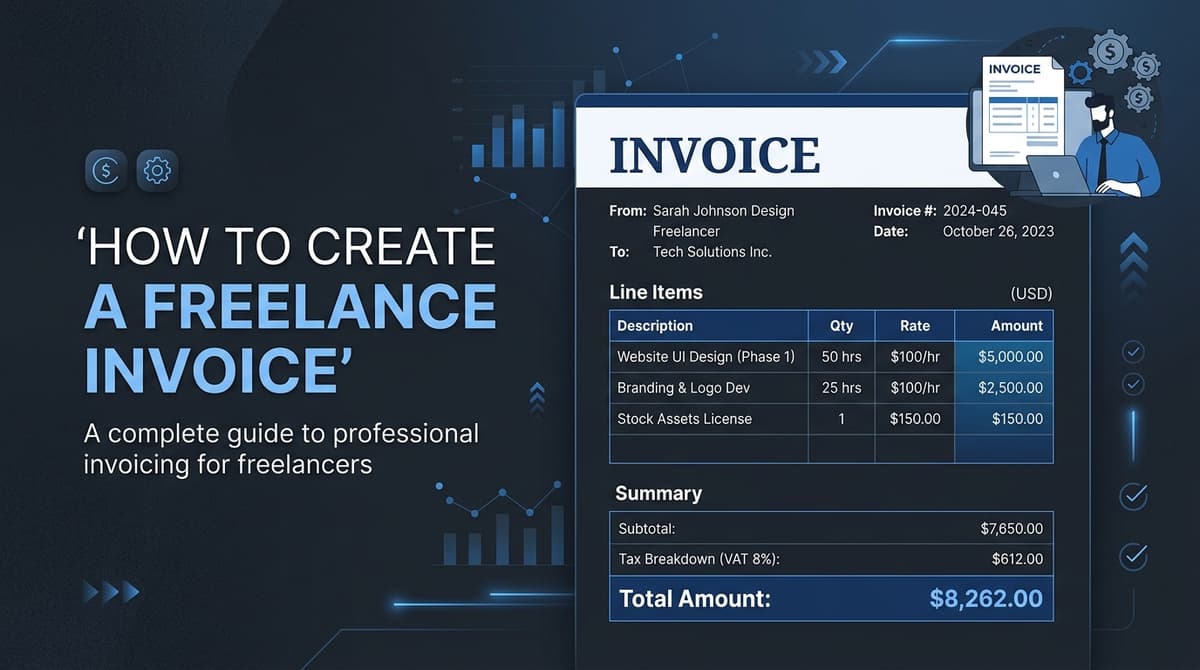
To pass through corporate accounts payable workflows smoothly, every invoice you issue must contain eight core structural components:
| Component | Purpose | Best Practice Example |
|---|---|---|
| 1. Header & Branding | Immediate visual identification | "Acme Digital Studio" + logo |
| 2. Your Business Details | Legal entity for IRS/HMRC matching | Full name, registered address, tax ID (EIN/VAT), email |
| 3. Client Details | Explicit corporate responsibility | Client company name, accounts payable department, physical address |
| 4. Invoice Metadata | Audit trail & tracking | Unique sequential ID (e.g. INV-2026-042), Issue Date, Due Date |
| 5. Itemized Breakdown | Verifiable description of work | Service description, hours/units, unit rate, line-item totals |
| 6. Financial Summary | Subtotal, discounts, statutory taxes | Subtotal, applicable sales tax or VAT rate %, Total Due |
| 7. Payment Instructions | Exactly how the client should pay | ACH routing/account, SWIFT/IBAN, or secure digital payment link |
| 8. Terms & Late Fees | Contractual payment expectations | "Payment due within 30 days. 1.5% monthly late charge on overdue balances." |
1. Unique Sequential Invoice Numbering#
Never issue an invoice labeled simply "Invoice 1" or repeat numbers across different clients. Accounts payable software requires unique identifier numbers to prevent duplicate disbursements.
A reliable alphanumeric convention combines the year with a sequential counter:
INV-2026-001
INV-2026-002
Alternatively, preface the number with client initials for multi-client clarity:
ACME-2026-01
TECH-2026-01
2. Itemizing Hourly vs Milestone Deliverables#
Avoid vague, single-line summaries such as "Consulting services: $3,500". Vague billing invites corporate review holds and delays payment approvals.
Instead, separate your deliverables into clear, verifiable lines:
- For Hourly Projects: Specify the project scope, total hours logged during the billing cycle, hourly rate, and total line cost.
- For Fixed-Price Milestones: Reference the specific milestone defined in your written proposal (e.g., "Milestone 2: Completion of User Interface Wireframes per Contract dated Jan 5, 2026").
Handling Taxes on Freelance Invoices#
Tax treatment on freelance invoices depends on whether you provide digital services, taxable tangible personal property, or professional labor, and whether your client is domestic or international:
US Sales Tax Considerations#
In the United States, pure professional services (such as legal advice, general copywriting, or strategy consulting) are exempt from sales tax in most states. However, several states (including Hawaii, New Mexico, South Dakota, and West Virginia) tax broad categories of professional services. Furthermore, if you deliver digital software products, website assets, or tangible goods, destination-based sales tax may apply.
Before billing, verify your state's statutory service tax rules using our US Sales Tax Calculator Hub.
UK & EU Value-Added Tax (VAT)#
If you operate a UK business registered for VAT with HM Revenue & Customs (mandatory if taxable turnover exceeds £90,000), your invoice must be a formal VAT Invoice. It must state:
- Your 9-digit UK VAT Registration Number (VRN).
- The tax point (time of supply).
- The net amount excluding VAT.
- The statutory VAT rate applied (typically 20% standard rate).
- The total VAT amount charged.
For cross-border B2B transactions between UK and EU entities, services frequently qualify for the Reverse Charge Mechanism, meaning you do not charge domestic VAT, but you must annotate the invoice: "Reverse charge: Customer to account for VAT under Article 196 of Council Directive 2006/112/EC." Check exact rates with our UK HMRC VAT Calculator.
Setting Payment Terms: Net 15, Net 30, and Late Fee Clauses#
Payment terms dictate when your client must legally remit payment following receipt of your invoice:
- Due Upon Receipt: Best for small initial deposits, quick one-off fixes, or new clients without an established credit history.
- Net 15 (Due within 15 calendar days): Ideal for freelancers and small agencies. Keeps cash flow velocity healthy while giving the client two full business weeks to process payment.
- Net 30 (Due within 30 calendar days): The standard corporate baseline for medium and enterprise companies with formal monthly accounts payable cycles.
Incorporating Early Payment Discounts & Late Fees#
To encourage fast settlement from corporate clients, consider offering a cash discount:
- 2/10 Net 30: The client receives a 2% discount if they remit payment within 10 days; otherwise, the full invoice balance is due in 30 days.
To protect against chronic delinquency, your invoice footer should always state the contractual late fee agreed upon in your master agreement:
"Payment terms: Net 30. Accounts unpaid after 30 days are subject to a statutory late service fee of 1.5% per month (18% per annum) or the maximum legal rate allowed by law, plus all costs of collection."
Payment Gateways & Merchant Processing Deductions#
When providing electronic payment options (such as credit card links via Stripe, PayPal, or Square), be aware that processors deduct interchange fees before funds reach your bank account:
- Standard US credit cards: 2.9% + $0.30 per charge.
- International payment cards: Additional 1.0% to 1.5% cross-border surcharge.
If your contract permits passing processing fees to clients, use our Stripe Fee Calculator to reverse-calculate the exact invoice gross total so that your net payout matches your contract agreement.
Checklist Before Sending Any Invoice#
Before emailing your invoice to a client, review this five-point quality control checklist:
- Verify Recipient Email: Confirm whether the invoice should go to your primary project contact or directly to
billing@clientcompany.comorinvoices@clientcompany.com. - Purchase Order (PO) Number: Check if your client issued a formal Purchase Order number. Invoices missing a PO number are frequently blocked by enterprise ERP accounting systems.
- Format as PDF: Never send editable Word documents or open spreadsheets. Send a finalized, locked PDF format to prevent unauthorized modifications and formatting distortion.
- Attach Timesheets or Approval Logs: For hourly contracts, attach your time summary sheet or reference the client's written milestone sign-off.
- Log in Your Accounting Records: Record the outstanding invoice in your bookkeeping ledger or accounting software to facilitate weekly accounts receivable aging audits.
You can create, customize, and export clean PDF invoices in seconds with zero watermarks or account sign-ups using the FeeKit Free Invoice Generator.
Common Inquiries & Regulations
What must be included on an independent freelance invoice?
A legally sound freelance invoice must contain: a unique sequential invoice number, your legal name/business name and contact information, the client's business name and address, invoice issue date, payment due date, an itemized description of services rendered with quantities or hours, the subtotal, applicable taxes (sales tax or VAT), and clear payment instructions (bank transfer details or online payment links).
When should a freelancer send an invoice to a client?
For project-based milestones, invoices should be sent immediately upon delivery or sign-off. For ongoing retainer clients or time-based contracts, invoices are typically sent on the 1st or 15th of each month, or bi-weekly according to the terms agreed upon in your master service agreement.
How do I enforce payment terms if a client pays late?
Include an explicit payment clause in your initial contract stating standard terms (e.g., Net 30 or Net 15) and a reasonable statutory late fee (typically 1.5% per month on overdue balances). Send automated or polite written reminder notices at 7 days before due date, on the due date, and at 7, 14, and 30 days overdue.
Test These Numbers With Your Exact Transaction Data
Don't guess your margins. Use FeeKit's free, client-side financial precision tools to model your exact gross revenue, deductions, and tax compliance: