
How to Calculate Profit Margin for a Service Business: Formulas & Benchmarks
Learn how to calculate gross and net profit margins for a service business, consulting firm, or agency. Understand direct labor COGS, overhead allocation, and healthy margin benchmarks.

In retail, e-commerce, and manufacturing, calculating gross profit margin is intuitive: you take your retail selling price, subtract the physical cost of the item from your supplier (plus freight and packaging), and divide by revenue.
In a service business, however, calculating margins is frequently misunderstood. When you sell consulting hours, design sprints, legal retainers, or software engineering contracts, your "inventory" is human talent, time, and intellectual property.
Many agency founders and service entrepreneurs celebrate a 60% gross margin on paper, yet finish the fiscal year with empty bank accounts because they fail to properly account for direct labor COGS, unbillable overhead, and client acquisition costs.
In this guide from the FeeKit Editorial Desk, we unpack the exact mathematical formulas for service gross and net margins, provide industry benchmark targets, and share practical strategies to prevent margin erosion. You can model your numbers instantly using our Profit Margin & Markup Calculator.
The Three Tiers of Profit Margins#
To analyze the financial health of a service business, you must examine three distinct margin layers:
| Margin Layer | Calculation Formula | What It Measures | Healthy Service Benchmark |
|---|---|---|---|
| 1. Gross Profit Margin | (Revenue - Direct Labor COGS) / Revenue × 100 | Production efficiency; direct profitability of client deliverables | 50% to 65% |
| 2. Operating Margin | (Gross Profit - Operating Overhead) / Revenue × 100 | Operational efficiency; cost of administrative support and marketing | 20% to 30% |
| 3. Net Profit Margin | (Operating Profit - Taxes & Interest) / Revenue × 100 | True bottom-line owner earnings retained after all expenses | 15% to 25% |
Step 1: Defining Cost of Goods Sold (COGS) for Services#
The most common mistake service businesses make is categorizing all employee and contractor salaries as general operating overhead.
To calculate true Gross Margin, you must separate your expenses into Cost of Services (COGS) and General Overhead (SG&A):
What Belongs in Service COGS:#
- Direct Billable Payroll: The hourly wages or prorated salaries of developers, designers, writers, or tradespeople working directly on client projects.
- Freelance Subcontractors: Third-party specialists hired for specific client deliverables.
- Project-Specific Software & Materials: Cloud server costs spun up specifically for a client, stock photography licenses, or pass-through materials.
What Belongs in Operating Overhead (OpEx / SG&A):#
- General management and administrative salaries (CEO, HR, internal bookkeeping).
- General agency software (Slack, Google Workspace, general accounting subscriptions).
- Company website hosting and marketing advertising spend.
- Office rent, legal retainers, and corporate insurance.
Step 2: The Mathematical Formulas#
1. Gross Profit Margin Formula#
Gross Profit = Client Revenue - Direct Labor COGS
Gross Margin % = (Gross Profit / Client Revenue) × 100
2. Net Profit Margin Formula#
Net Profit = Gross Profit - Operating Overhead (SG&A) - Taxes
Net Margin % = (Net Profit / Client Revenue) × 100
3. Markup vs Margin Relationship#
Markup % = ((Revenue - Cost) / Cost) × 100
Margin % = Markup % / (1 + Markup %)
Example: If a project costs your agency $5,000 in direct contractor fees and you bill the client $10,000:
- Your Markup is ($10,000 - $5,000) / $5,000 = 100%.
- Your Gross Margin is ($10,000 - $5,000) / $10,000 = 50%.
Worked Example: A Digital Agency Project#
Let's analyze a concrete case study for an agency contracted to build a custom web application for $30,000:
| Expense Component | Cost Detail | Subtotal |
|---|---|---|
| Contract Revenue | Client project fee | $30,000 |
| Direct Labor COGS | Senior Developer: 80 hours @ $65/hr = $5,200 | |
| UI/UX Designer: 40 hours @ $55/hr = $2,200 | ||
| QA Tester: 20 hours @ $35/hr = $700 | ||
| Client Cloud Hosting Infrastructure = $400 | ||
| Total Service COGS | $8,500 | |
| Gross Profit | $30,000 - $8,500 | $21,500 |
| Gross Margin % | ($21,500 / $30,000) × 100 | 71.67% |
Now let's factor in the agency's monthly overhead allocated to this project:
- Project share of marketing, sales acquisition, and proposal drafting: $4,500
- Software tools (Figma, GitHub, Slack, Project Management): $800
- Legal, accounting, and merchant payment processing fees: $1,200
- Total Overhead Allocated: $6,500
Pre-Tax Operating Profit = $21,500 - $6,500 = $15,000
Operating Net Margin % = ($15,000 / $30,000) × 100 = 50.0%
This project represents a highly profitable deliverable that exceeds standard industry benchmarks.
The Rule of Thirds: Service Agency Budgeting#
Many successful professional services firms operate by the classic Rule of Thirds:
- 33% to Direct Labor (COGS): One-third of gross client revenue goes directly to the people executing the work.
- 33% to Overhead (SG&A): One-third covers sales, marketing, management, rent, and software.
- 33% to Net Operating Profit: One-third remains as pre-tax profit for owner distributions, bonuses, and growth capital.
If your direct labor costs creep above 45% to 50% of gross revenue, your gross margin will compress below 50%, leaving insufficient margin to cover overhead and yielding anemic net profits.
Five Levers to Expand Service Margins#
If your current profit margin is compressed, apply these proven operational adjustments:
- Eliminate Scope Creep with Milestone Invoicing: Unbilled extra revisions silently destroy project margins. State exact deliverable limits in your proposals and issue change-order invoices for additional requests using our Free Invoice Generator.
- Increase Billable Utilization: Track how many hours your staff spend on unbillable internal meetings versus billable client work. Raising team utilization from 55% to 70% drastically lowers direct hourly cost.
- Transition to Value-Based Pricing: Hourly billing caps your revenue at the number of hours in a day. Packaging deliverables into fixed, outcome-based pricing allows experienced teams to capture efficiency gains as pure profit margin.
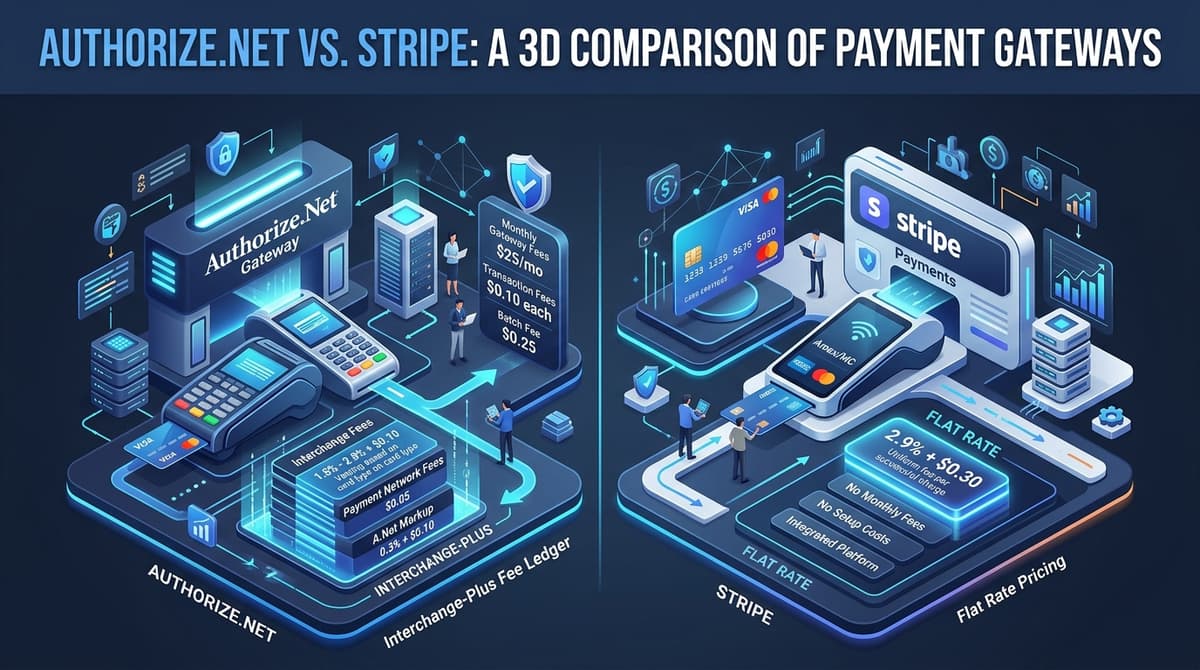
- Pass-Through Merchant Processing Fees: When clients pay via credit card, gateway processors take 2.9% + $0.30. On a $20,000 invoice, that represents a $600 margin reduction. Use our Stripe Fee Calculator to reverse-calculate invoices or incentivize ACH wire transfers.
- Review Fixed Overhead Regularly: Audit recurring software subscriptions and cancel redundant licenses every quarter.
Explore our Small Business Resources Hub to model break-even unit volumes, calculate contractor hourly rates, and explore 50-state sales tax rules.
Common Inquiries & Regulations
What is Cost of Goods Sold (COGS) for a service business?
In a service business, Cost of Goods Sold (often termed Cost of Services) consists of direct costs required to deliver the client work. This primarily includes direct billable labor (wages or contractor fees paid to staff who execute the project), specialized project software licenses, and direct client travel/materials. General administrative salaries, office rent, and corporate marketing are operating expenses (OpEx), not COGS.
What is a healthy profit margin for an agency or consulting firm?
Healthy service business benchmarks typically target: Gross Profit Margin between 50% and 65%, and Net Profit Margin (pre-tax) between 15% and 25%. Elite boutique consultancies and specialized agencies frequently achieve 25% to 35% net profit margins.
How do I convert markup into profit margin?
Markup is profit divided by cost, while margin is profit divided by revenue. You can convert markup into profit margin using the formula: Margin % = Markup % / (1 + Markup %). For example, a 100% markup corresponds to a 50% profit margin.
Test These Numbers With Your Exact Transaction Data
Don't guess your margins. Use FeeKit's free, client-side financial precision tools to model your exact gross revenue, deductions, and tax compliance: