
How to Pass Credit Card Processing Fees to Customers Legally (2026 Rules & Calculator)
Can you pass credit card fees to clients in 2026? State-by-state surcharge laws, the Visa 3% cap, debit card prohibitions, cash discount vs surcharge formulas, and compliant invoice templates.

Every small business owner, service professional, contractor, and freelance agency faces the same painful reality at the end of every fiscal month: payment processing fees eat between 2.5% and 4.0% of their top-line gross revenue.
On $100,000 in annual invoicing, merchant fees quietly vaporize $3,000 to $4,000 in cold, hard profit. On $1,000,000 in volume, that drag balloons to $35,000+ per year—the equivalent of an entire junior employee's salary or an essential marketing budget.
As inflation and processing rates climb, more merchants are asking:
"Can I just pass the credit card fee to the customer so they pay for their own reward points?"
The short answer is yes, but only if you comply with strict federal statutes, card network rules, and state-by-state disclosure laws.
Make one false step—such as charging a fee on a debit card, exceeding card network caps, or failing to register with your card brands—and you risk $5,000 to $25,000 monthly non-compliance fines, chargeback disputes, or immediate termination of your merchant processing account.
In this authoritative 2026 operational guide, the FeeKit Financial Engineering Team breaks down everything you need to legally and profitably offset payment processing costs: state-by-state legal status, card network compliance requirements, the mathematical gross-up formula, and ready-to-copy client contract clauses.
Use our free Stripe Fee & Reverse Payout Calculator to compute exact compliant invoice amounts in real time.
Surcharge vs. Cash Discount vs. Convenience Fee#
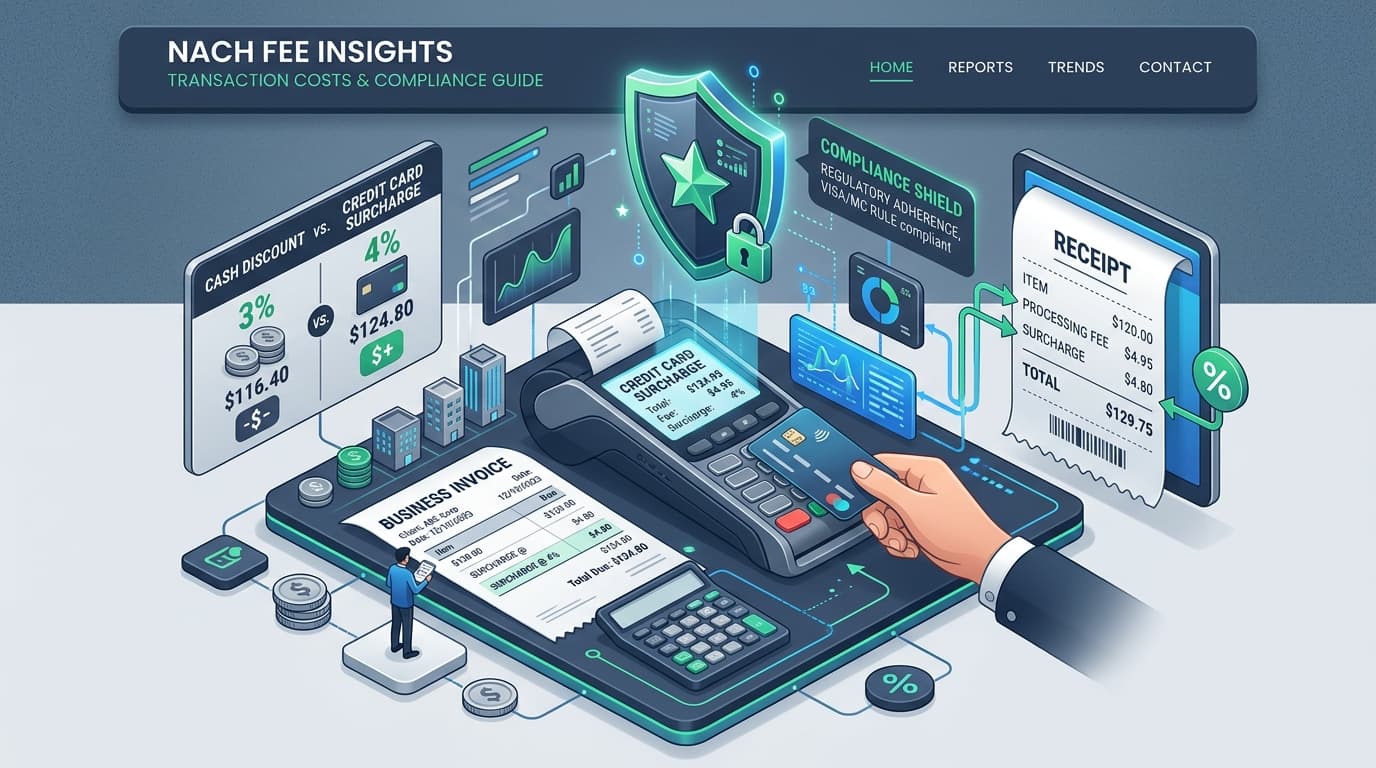
Before implementing any pricing change, you must understand the critical legal distinction between the three standard fee-recovery mechanisms recognized in the financial sector:
| Pricing Mechanism | What It Does | Debit Card Allowed? | 50-State Legal? | Network Registration Required? |
|---|---|---|---|---|
| Credit Card Surcharge | Adds an extra percentage fee (max 3%) to a customer's bill when they choose to pay via credit card. | STRICTLY NO | No (Banned in CT, MA, PR; strict rules in NY, CA) | Yes (Visa/MC 30-day notice) |
| Cash / ACH Discount | Posts regular prices and offers a percentage or dollar reduction for paying cash, check, or ACH bank transfer. | YES | YES (All 50 States) | No |
| Convenience Fee | Flat fee assessed for providing an alternative payment channel (e.g., paying online when standard is by mail). | Yes (if channel meets rule) | Yes (with strict channel rules) | No |
1. Credit Card Surcharge (Checkout Fee)#
A surcharge is an explicit extra charge added to the posted price when a buyer selects a credit card. It is designed to offset your merchant discount rate (MDR). Because consumer advocacy groups historically opposed surcharges, they are subject to heavy regulatory oversight and card network restrictions.
2. Cash Discount (The Bulletproof Alternative)#
Under federal law (the Durbin Amendment of the Dodd-Frank Act, 12 U.S.C. § 1693o-2), all merchants across all 50 US states have an explicit, protected right to offer a discount to encourage customers to pay by cash, check, or electronic bank transfer (ACH).
Instead of showing a $1,000 service fee and adding a $30 credit card fee, you set the base price at $1,030 and offer a $30 (or ~3%) discount for clients who pay via ACH or cash. This achieves the exact same financial result with zero risk of state surcharge litigation.
3. Convenience Fees#
Convenience fees are frequently misunderstood. Under Visa and Mastercard rules, a convenience fee cannot simply be tacked onto everyday in-person or routine card payments. A convenience fee is only permissible if:
- It is a flat, fixed fee (not a percentage).
- It is assessed for a payment channel that is truly alternative and outside your normal business practice (for example, a municipal water utility that accepts bill payments online or by phone rather than by mail).
2026 Card Brand Rules: Visa, Mastercard, Amex & Discover#
If you decide to implement a true credit card surcharge, you must follow the strict operating regulations set by the major payment networks. Failure to follow these rules is the #1 reason merchant accounts receive compliance penalties.
1. The 3.0% Surcharge Cap (Updated Regulation)#
For over a decade, merchant blogs claimed the maximum credit card surcharge was 4.0%. This is dangerously outdated.
Critical Compliance Note: In April 2023, Visa officially reduced its maximum surcharge cap from 4.0% down to 3.0% (or your actual effective cost of card acceptance, whichever is lower). Mastercard enforced a matching 3.0% limit.
If your effective merchant processing fee on an invoice is 2.8%, you cannot surcharge 3.0%. You can only surcharge up to your actual cost of acceptance (2.8%). Surcharging more than your actual processing cost turns the surcharge into a profit center, which directly violates merchant agreements.
2. The Strict Prohibition on Debit Cards (Even Run as "Credit")#
This is where thousands of businesses unknowingly violate federal law:
You CANNOT surcharge a debit card under any circumstance.
This ban applies to:
- PIN debit cards
- Signature debit cards (when a customer runs their bank card as "credit" at the terminal)
- Prepaid debit cards (payroll cards, gift cards, reloadable cards)
If your point-of-sale terminal or online checkout software cannot automatically detect bank identification numbers (BINs) to block surcharges on debit cards, you cannot legally surcharge card payments. Modern merchant terminals dynamically inspect the card BIN: if it's a credit card, the surcharge applies; if it's a debit card, the surcharge is suppressed.
3. The 30-Day Network Notification Requirement#
Before assessing your first surcharge, Visa and Mastercard require you to submit written notification to your payment processor (acquirer) at least 30 days in advance.
Most major merchant processors (Square, Stripe, Clover, Fiserv) provide a one-click surcharge onboarding form or dashboard toggle that automatically logs this compliance registration with the card brands.
4. Itemization on Receipts and Invoices#
The surcharge amount must appear as a distinct line item on the customer's invoice and physical or electronic receipt. You cannot silently bundle the surcharge into the item price or sales tax line.
5. Level Playing Field (No Brand Discrimination)#
Under American Express and Discover rules, you cannot single out one card brand for a surcharge while letting another brand process for free. If you surcharge Visa and Mastercard, you must treat American Express equally, subject to their specific acceptance guidelines.
State-by-State Legal Map: Where Is Surcharging Allowed in 2026?#
Historically, 10 states maintained statutory bans against credit card surcharges. However, following the landmark Supreme Court ruling in Expressions Hair Design v. Schneiderman (2017)—which held that surcharge bans regulate commercial speech under the First Amendment—courts struck down bans in Texas, Florida, Kansas, and Illinois.
Here is the authoritative legal status across US jurisdictions in 2026:
States With Active Prohibitions or Restrictions#
- Connecticut (Conn. Gen. Stat. § 42-133ff): Surcharging remains strictly prohibited by statute. Cash discounts are permitted.
- Massachusetts (Mass. Gen. Laws ch. 140D, § 28A): Credit card surcharges are illegal. Retailers may only offer cash discounts.
- Puerto Rico (10 L.P.R.A. § 11): Surcharges on consumer credit card purchases are prohibited.
- Colorado (Colo. Rev. Stat. § 5-2-212): Surcharges are legal, but Colorado state law caps the maximum allowable surcharge at 2.0% (or the merchant's actual cost of card acceptance), which is lower than the 3.0% card brand cap.
States With Strict "All-In Pricing" & Disclosure Mandates#
- New York (N.Y. Gen. Bus. Law § 518 — Amended Feb 2024): Surcharges are permitted, but businesses must display the highest total credit card price prior to payment. A merchant can no longer post a $50 price tag and state in small print "3% credit card fee added at checkout". You must post the $51.50 credit card price and may note a discounted $50 cash price.
- California (Honest Pricing Law — Effective 2024 / AB 537 & SB 478): Requires advertised prices to include all mandatory fees. Businesses cannot hide surcharges in late checkout screens. Clear, prominent upfront disclosure of payment-method pricing is required.
- Maine (Me. Rev. Stat. tit. 9-A, § 8-509): Surcharging is permitted only if the merchant clearly discloses the surcharge percentage prior to payment.
All Other States (Legal with Federal & Card Brand Compliance)#
In all remaining states (Texas, Florida, Illinois, Ohio, Pennsylvania, North Carolina, Georgia, Washington, etc.), surcharging credit cards is legal provided you:
- Limit the surcharge to actual cost (max 3.0%).
- Exclude all debit and prepaid cards.
- Provide clear signage at point of entry and POS checkout.
- Itemize the surcharge separately on customer receipts.
The Hidden Math Trap: Why Simple Addition Leaves You Short#
The single most common financial mistake merchants make when attempting to pass processing fees is using simple addition rather than the gross-up formula.
The Flawed Logic:#
Suppose you perform a $1,000 professional consulting service. Your merchant fee rate is 3.0%.
- You think: "I'll just add 3% ($30) to the invoice, making it $1,030."
- The client pays $1,030 via credit card.
- Your payment gateway deducts 3% of the total charged amount:
Processor Fee = 3% × $1,030.00 = $30.90 - Your net deposit from the processor:
Net Payout = $1,030.00 - $30.90 = $999.10
You are still short $0.90. On a $50,000 corporate invoice, that rounding error costs you $45.00 to $75.00 per transaction. Over dozens of invoices each month, you leak hundreds of dollars.
The Correct Gross-Up Formula:#
Payment processors calculate their percentage fee against the gross total, which includes the fee itself plus any fixed transaction charge (e.g., Stripe's $0.30 fixed fee).
To receive an exact targeted net payout, you must use the standard financial gross-up equation:
Gross Invoice Amount = (Desired Net Amount + Fixed Fee) ÷ (1 - Variable Fee Rate)Example: Charging $1,000 on Stripe (2.9% + $0.30)
- Desired Net: $1,000.00
- Fixed Fee: $0.30
- Variable Rate: 0.029 (2.9%)
Gross Invoice = ($1,000.00 + $0.30) ÷ (1 - 0.029)
              = $1,000.30 ÷ 0.971
              = $1,030.18
When the client pays $1,030.18:
- Processor fee:
($1,030.18 × 0.029) + $0.30 = $29.88 + $0.30 = $30.18 - Your net payout:
$1,030.18 - $30.18 = $1,000.00(Exact to the penny).
Pro Tip: Test your own transaction numbers instantly using our Stripe Fee & Reverse Payout Calculator.
Live Surcharge & Gross-Up Calculator Live Tool
Calculate exact gross-up totals and avoid losing 3% to card processors
4 Compliant Ways to Recover Fees Without Upsetting Clients#
Passing fees directly to clients can cause friction if handled poorly. Here are the four most professional, client-friendly ways to implement fee recovery:
Strategy 1: The "Dual-Price Cash Discount" (Recommended for B2B)#
Instead of penalizing credit card payers, reward bank and ACH payers.
- In your proposals and invoices, display:
- Standard Credit Card Price: $5,150
- Discounted Direct Bank (ACH / Wire) Price: $5,000 (Save $150)
- Why it works: Clients view a discount as positive value rather than a punitive surcharge, and it is 100% legal in all 50 states without card brand paperwork.
Strategy 2: Default to Zero-Fee Bank Transfers (ACH / Plaid)#
If you bill via invoicing software (QuickBooks, FreshBooks, or Stripe Invoicing), disable credit card payments on invoices over $2,000.
- On Stripe, credit cards cost 2.9% + $0.30 ($145 on a $5,000 invoice).
- ACH Direct Debit on Stripe costs 0.8% capped at $5.00.
- By making ACH the default payment link, you save $140.00 on that single invoice, and the client experiences a seamless 30-second bank login via Plaid.
Strategy 3: Build Processing Overhead Into Base Service Pricing#
If your business experiences an average 2.7% payment processing drag across all revenue, raise your general service rates by 3.0% across the board.
- When you bake processing costs directly into your hourly rates or project packages, you eliminate all client awkwardness, POS signage requirements, and state compliance headaches.
- Clients who pay by check or ACH simply contribute higher profit margins to your business.
Strategy 4: Compliant Point-of-Sale Surcharging (Retail & Counter Service)#
If you operate a physical storefront, medical office, or repair shop:
- Ensure your credit card terminal automatically detects debit vs. credit cards.
- Post clear signage at the shop entrance and checkout register stating:
"We assess a 3.0% surcharge on credit card payments, which reflects our cost of card acceptance. We do not surcharge debit cards or cash."
- Ensure the line item clearly prints on customer receipts.
Free Ready-to-Use Invoice & Contract Language Templates#
To protect your business legally and set clear expectations with clients, copy and customize these compliant clauses:
Template 1: Invoice Payment Terms Clause (Dual Pricing / ACH Discount)#
PAYMENT TERMS & PAYMENT METHODS:
Payment is due within 30 days of invoice date.

• Preferred Payment (ACH / Wire / Check): Total Due: $5,000.00
  Please remit via the ACH bank transfer link on this electronic invoice.

• Credit Card Payment: Total Due: $5,150.00
  Credit card payments incur a 3.0% card processing surcharge reflecting
  our actual cost of acceptance. Debit cards are not subject to surcharges.
Template 2: Master Services Agreement (MSA) Contract Clause#
Section 4.3 — Payment Methods & Processing Surcharges.
Client agrees to remit payment via ACH electronic bank transfer, wire transfer,
or corporate check without additional assessment. In the event Client elects
to pay any invoice via credit card, Client acknowledges and agrees that a credit
card processing surcharge equal to Provider's actual cost of merchant card
acceptance (not to exceed 3.0%) shall be assessed and itemized on the final
transaction receipt. In accordance with federal operating regulations, no
surcharges shall be assessed on debit card transactions.
Template 3: Physical POS Counter Signage (Printable)#
CUSTOMER NOTICE: CREDIT CARD SURCHARGE
To offset the rising costs of merchant card processing, a 3.0% surcharge
will be applied to all credit card purchases. This fee does not exceed our
cost of credit card acceptance.

WE NEVER SURCHARGE DEBIT CARDS OR CASH.
Thank you for supporting our independent business!
Frequently Asked Questions & Practical Scenarios#
Can I pass Stripe processing fees to clients using Stripe Invoicing?#
Yes. Stripe Invoicing allows merchants in eligible jurisdictions to enable automatic surcharge calculation or configure customer-facing fee line items. However, you must verify that your business address is not in a restricted state (such as Massachusetts or Connecticut) and that you do not surcharge debit card numbers.
Does American Express allow surcharging?#
Yes, but American Express requires that you do not discriminate against Amex. You cannot surcharge Amex at a higher rate than other credit cards, and you cannot surcharge Amex while letting Visa or Mastercard process without a surcharge.
What should I do if a client pushes back on paying credit card fees?#
The simplest, most professional response is:
"We strive to keep our core service rates as competitive as possible rather than inflating our prices across the board. To do this, we offer zero-fee bank transfers (ACH/wire) as our standard payment method. If your team prefers the convenience or reward points of a corporate credit card, we simply pass through the processor's direct cost of acceptance."
Most B2B clients immediately understand and switch to ACH without complaint.
Summary Checklist for Compliant Fee Recovery in 2026#
Before launching surcharges in your business:
- Verify Your State: Confirm you are not operating in Connecticut, Massachusetts, or Puerto Rico. If in New York or California, adhere strictly to all-in price disclosure laws.
- Cap at 3.0%: Never surcharge more than your actual cost of acceptance, and never exceed the 3.0% Visa/Mastercard ceiling (or 2.0% in Colorado).
- Notify Your Processor: File the mandatory 30-day notice with your merchant acquirer.
- Block Debit Cards: Verify that your software or POS hardware automatically exempts debit and prepaid cards.
- Itemize Clearly: Ensure the surcharge appears as an independent line item on receipts and invoices.
- Use the Reverse Formula: Compute exact gross totals using FeeKit's Reverse Fee Calculator so rounding errors don't erode your margins.
By following these rules, your business can protect thousands of dollars in annual operating profit while maintaining 100% legal compliance and strong customer relationships.
Common Inquiries & Regulations
Is it legal to pass credit card processing fees to customers in 2026?
Yes, in the vast majority of US states, credit card surcharging is legal provided you follow card brand regulations (Visa, Mastercard, American Express, Discover) and state disclosure laws. However, surcharging remains banned or heavily restricted in Connecticut, Massachusetts, and Puerto Rico. Several states, including New York and California, require strict all-in pricing or prominent dual-pricing displays.
Can I legally add a surcharge to debit card or prepaid card payments?
No. Federal law under the Durbin Amendment and payment network operating rules strictly prohibit surcharges on debit cards and prepaid cards, even if the cardholder chooses 'credit' or provides a signature at the payment terminal. Surcharging a debit card is a severe violation that can result in immediate merchant account termination and fines up to $25,000 per occurrence.
What is the maximum credit card surcharge percentage allowed in 2026?
Visa and Mastercard cap credit card surcharges at a maximum of 3.0% (lowered from the former 4.0% cap in April 2023) or your actual effective cost of card acceptance, whichever is lower. Furthermore, Colorado state law caps surcharges at 2.0% or the actual merchant cost. You cannot treat surcharges as a profit center.
What is the difference between a credit card surcharge and a cash discount?
A credit card surcharge adds an extra fee on top of your standard posted price when a buyer pays with a credit card. A cash discount offers a reduction from your regular posted price when the customer pays with cash, check, or ACH direct debit. Cash discounts are 100% legal in all 50 US states without state-level surcharge restrictions.
Why does adding 3% to an invoice still leave the merchant short on fees?
Standard addition fails because payment processors apply their percentage cut to the total transaction amount (including the fee itself). For a $1,000 invoice with a 3% fee, adding $30 totals $1,030. The processor then deducts 3% of $1,030 ($30.90), leaving you with $999.10. To receive exactly $1,000, you must use the reverse gross-up formula: $1,000 / (1 - 0.03) = $1,030.93.
Test These Numbers With Your Exact Transaction Data
Don't guess your margins. Use FeeKit's free, client-side financial precision tools to model your exact gross revenue, deductions, and tax compliance: